
RetatrutideTriple Receptor Agonist
An independent overview of the investigational peptide retatrutide: a synthetic triple agonist of the GLP-1, GIP, and glucagon receptors developed by Eli Lilly and currently in late-stage clinical evaluation for obesity and metabolic disease.
For laboratory research and educational reference only. Not a drug, supplement, or treatment. Not for human consumption.
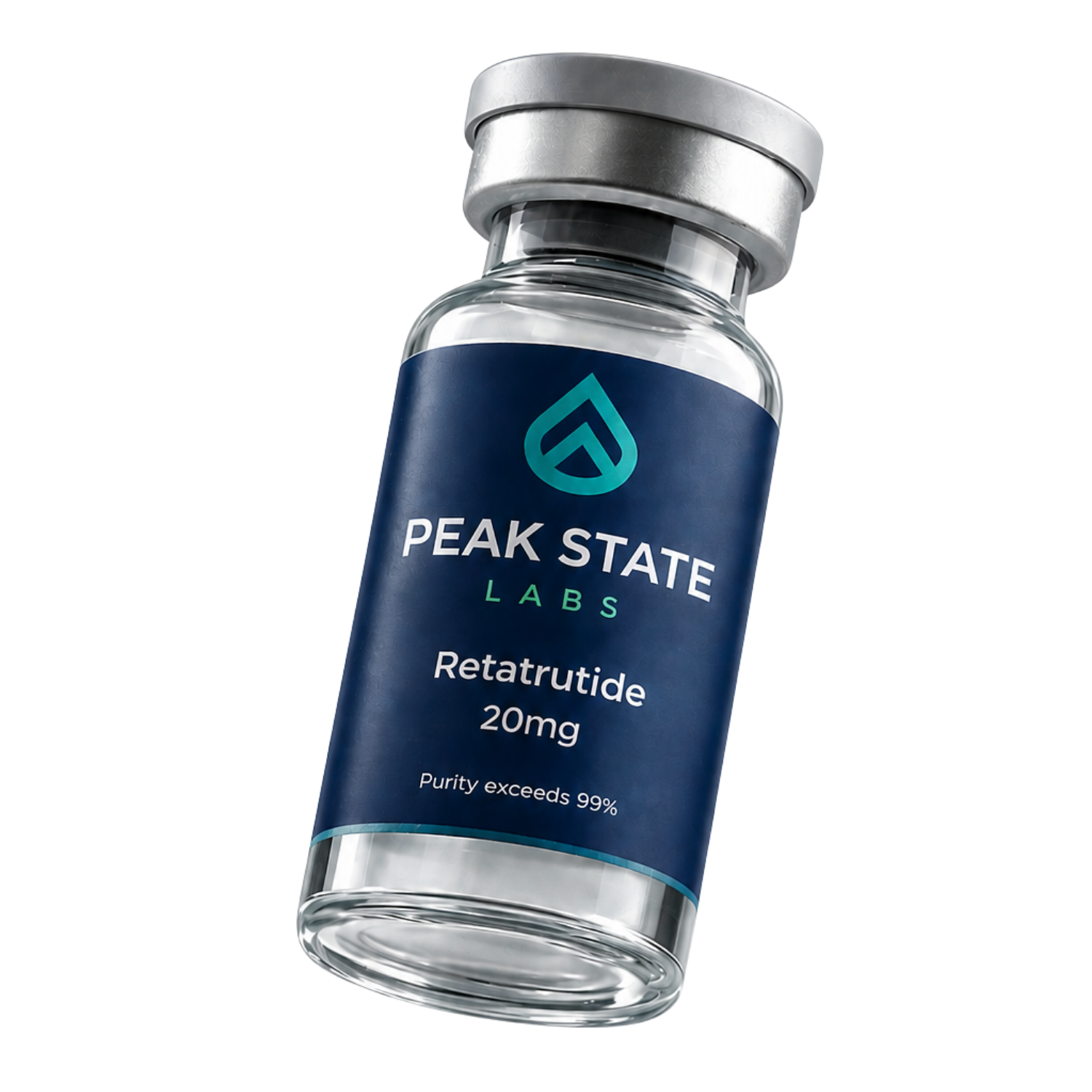
Compound
LY-3437943
Class
Triple Agonist
Targets
GLP-1 / GIP / GCG
Half-life
~6 days
Overview
Retatrutide (developmental code LY-3437943) is an investigational synthetic peptide developed by Eli Lilly. It is notable for activating three incretin and metabolic hormone receptors simultaneously: the glucagon-like peptide-1 (GLP-1) receptor, the glucose-dependent insulinotropic polypeptide (GIP) receptor, and the glucagon (GCG) receptor.
Where earlier peptides such as semaglutide acted on a single receptor (GLP-1) and tirzepatide added a second (GIP), retatrutide extends this approach by adding glucagon receptor activity. The intended outcome of the third agonism is increased basal energy expenditure and lipid mobilization on top of the appetite and glycemic effects of GLP-1 / GIP signaling.
As of the most recent published results, retatrutide remains an investigational compound undergoing Phase 3 clinical trials and is not approved by the FDA, EMA, or any other regulatory body. Material referenced on this page is intended for laboratory research and educational reading only.
Mechanism of Action
Retatrutide's effects derive from three parallel signaling pathways. Each receptor contributes a different piece of the metabolic picture.
Glucagon-like peptide-1
Slows gastric emptying, enhances glucose-dependent insulin secretion, and acts centrally to reduce appetite and food intake.
Glucose-dependent insulinotropic polypeptide
Augments insulin response to nutrients and is thought to modulate adipose tissue lipid handling and energy storage.
Glucagon
Increases hepatic glucose output but also raises basal energy expenditure and promotes lipolysis — the differentiating mechanism vs. dual agonists.
The receptor balance is intentionally tilted: GLP-1 and GIP activity dominate the glycemic and appetite response, while glucagon activity is calibrated to add an energy-expenditure contribution without producing the hyperglycemia historically associated with pure glucagon agonism.
Pharmacokinetics
| Molecular class | 39-amino-acid peptide with C20 fatty diacid moiety |
|---|---|
| Administration (research) | Subcutaneous injection |
| Reported half-life | ~6 days (supports once-weekly dosing in trials) |
| Time to steady state | Approximately 4 weeks of weekly administration |
| Elimination | Proteolytic degradation; no renal dose adjustment reported in trials |
Research Findings
Published Phase 2 results have drawn significant attention to retatrutide's magnitude of effect relative to other incretin agents.
~24%
Mean body-weight reduction at 48 weeks at the highest dose in the Phase 2 obesity trial.
Phase 3
Currently in ongoing Phase 3 trials (TRIUMPH program) for obesity and related conditions.
Dose-dependent
Weight and HbA1c response scaled with dose across the 1 mg / 4 mg / 8 mg / 12 mg arms tested.
Hepatic fat
Sub-studies have reported substantial reductions in hepatic steatosis (MASLD/NAFLD).
Numbers above are summarized from peer-reviewed publications; see references below.
What to Expect
A general timeline of how response has progressed across published Phase 2 trial data. Individual results vary; figures below are ranges reported in clinical research and are not promises.
Week 1 – 2
Early appetite suppression begins as triple-receptor activity ramps up; mild gastrointestinal effects are common during initial adaptation.
Week 2 – 4
Noticeable reduction in cravings and portion size. Early body-weight reduction in the 2 – 5% range begins to appear.
Week 4 – 8
Steadier appetite control and continued weight reduction (typically 5 – 10%). Glycemic markers improve in subjects with type-2 diabetes.
Week 8 – 16
Substantial body-weight reduction (10 – 18%) accompanied by increased basal energy expenditure and broader metabolic improvements.
Week 16 – 24
A major weight-loss milestone (15 – 22%) with cardiovascular markers improving and reductions in hepatic fat reported.
Week 24 – 48
Maximum efficacy observed in trials (up to ~24% mean reduction at the highest dose) with comprehensive metabolic improvements and sustained benefits.
Timeline values reflect group-level outcomes from published trials. Adherence, dose, baseline weight, and lifestyle inputs all materially influence individual response.
Reported Research Dosing
The following weekly schedule reflects the dose-titration design used in published clinical research. It is provided for reference only and is not a recommendation for human use.
| Phase | Weeks | Weekly dose (research) |
|---|---|---|
| Initiation | 1 – 4 | 0.5 – 2 mg |
| Titration A | 5 – 8 | 4 mg |
| Titration B | 9 – 12 | 6 – 8 mg |
| Maintenance | 13+ | Up to 12 mg (highest arm tested) |
Slow titration is consistent across published trials and is associated with reduced gastrointestinal adverse events.
Reconstitution & Storage
Reconstitution (research handling)
- • Reconstitute lyophilized peptide with bacteriostatic water for injection.
- • Inject diluent slowly down the side of the vial; do not shake.
- • Swirl gently until fully dissolved.
- • Volume of diluent determines final mg-per-unit concentration.
Storage
- • Lyophilized: refrigerate at 2 – 8 °C; long-term store at −20 °C.
- • Reconstituted: refrigerate at 2 – 8 °C and use within manufacturer-stated stability window.
- • Protect from light.
- • Avoid repeated freeze-thaw cycles after reconstitution.
Storage parameters are general guidance for lyophilized peptide handling and may vary by batch — always defer to lot-specific documentation.
Reported Adverse Events in Clinical Trials
The adverse event profile reported in the published Phase 2 trials is consistent with the broader incretin-agonist class. Most events were graded mild to moderate, were dose-related, and occurred during titration.
This list summarizes published trial data and is not exhaustive. Long-term safety remains under evaluation as Phase 3 progresses.
Where Retatrutide Sits in the Incretin Class
| Compound | Receptor targets | Status |
|---|---|---|
| Semaglutide | GLP-1 | Approved |
| Tirzepatide | GLP-1 + GIP | Approved |
| Retatrutide (LY-3437943) | GLP-1 + GIP + Glucagon | Phase 3 / investigational |
References
- Jastreboff AM, et al. Triple–Hormone-Receptor Agonist Retatrutide for Obesity — A Phase 2 Trial. NEJM, 2023.
- Rosenstock J, et al. Retatrutide in Type 2 Diabetes — Phase 2 results. The Lancet, 2023.
- Sanyal AJ, et al. Effect of retatrutide on hepatic steatosis — sub-study analysis. 2024.
- Eli Lilly investor materials and ClinicalTrials.gov entries for the TRIUMPH program (Phase 3).
Citations are provided for educational reference. Refer to the original publications for full methodology and results.
Retatrutide is part of the POWER CUT™ Stack
Peak State Labs supplies retatrutide alongside CJC-1295 + Ipamorelin and BPC-157 + TB-500 in a single coordinated stack — with full third-party purity testing on every batch.