
CJC-1295 + IpamorelinGHRH Analog + Selective GH Secretagogue
An independent overview of the CJC-1295 (no DAC) + Ipamorelin blend: a modified GHRH analog paired with a selective ghrelin-receptor agonist. Together they drive a pulsatile, physiologic release of endogenous growth hormone without disturbing cortisol, prolactin, or ACTH.
For laboratory research and educational reference only. Not a drug, supplement, or treatment. Not for human consumption.
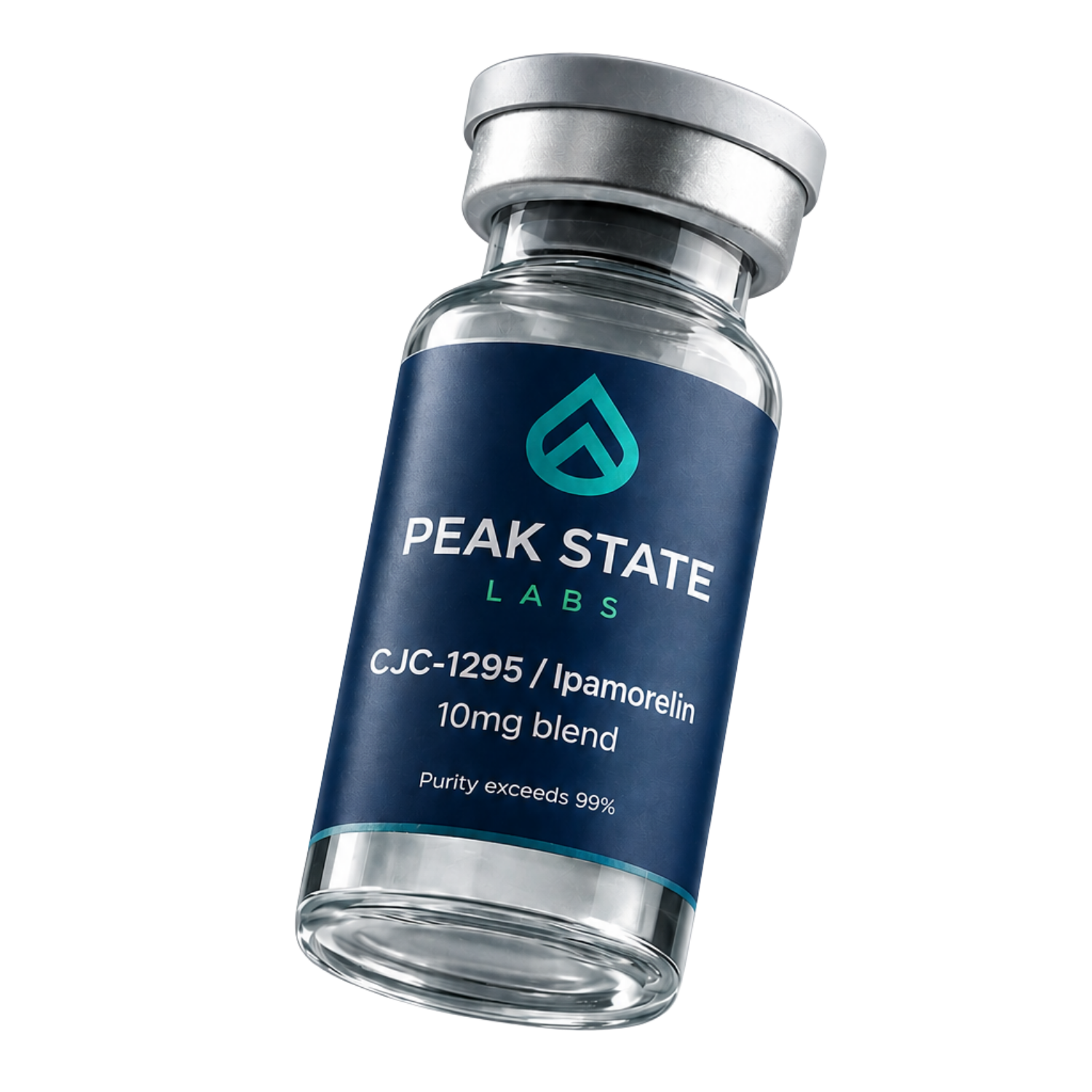
Blend
5 mg + 5 mg
Class
GHRH + GHRP
Targets
GHRH-R / GHSR-1a
Half-life
~30 min / ~2 h
Overview
The CJC-1295 + Ipamorelin protocol is one of the most widely studied combinations in growth-hormone research. It pairs CJC-1295 (no DAC) — also known as Modified GRF (1-29), a tetrasubstituted analog of the first 29 amino acids of endogenous GHRH — with Ipamorelin, a selective pentapeptide growth-hormone secretagogue.
CJC-1295 (no DAC) acts upstream at the GHRH receptor on the anterior pituitary, while Ipamorelin acts at the ghrelin / growth-hormone-secretagogue receptor (GHSR-1a). Because the two peptides recruit GH through complementary, parallel pathways, the combination produces a markedly larger pulsatile GH release than either compound alone — without the cortisol, prolactin, or ACTH disturbance characteristic of older non-selective secretagogues.
Both peptides remain investigational research compounds. They are not approved by the FDA, EMA, or any other regulatory body for human therapeutic use. Material referenced on this page is intended for laboratory research and educational reading only.
Mechanism of Action
The blend pulls on two independent levers of growth-hormone physiology. Each peptide contributes a distinct, additive signal at the somatotroph.
CJC-1295 (no DAC) — Modified GRF (1-29)
A 29-amino-acid GHRH analog that binds the GHRH receptor on pituitary somatotrophs. Activation drives cAMP/PKA signaling, increasing GH synthesis and amplifying the size of each natural GH pulse. The four amino-acid substitutions resist DPP-IV cleavage and improve stability vs. native GHRH.
Ipamorelin — selective ghrelin-receptor agonist
A pentapeptide GH secretagogue that binds GHSR-1a via Gq/11-linked calcium signaling. Triggers GH release without measurable elevation in cortisol, ACTH, prolactin, or aldosterone — the cleanest profile in the GHRP class.
Because GHRH-R and GHSR-1a recruit GH via different second messengers, co-administration produces a synergistic — not merely additive — pulse. The use of CJC-1295 without DAC is intentional: the short half-life preserves the natural pulsatile architecture of GH release rather than creating a continuous "bleed" of the hormone, which would blunt receptor sensitivity over time.
Pharmacokinetics
| CJC-1295 (no DAC) — class | 29-amino-acid modified GHRH analog (Mod GRF 1-29) |
|---|---|
| Ipamorelin — class | Synthetic pentapeptide GH secretagogue |
| Administration (research) | Subcutaneous injection |
| CJC-1295 half-life | ~30 minutes (short pulse to mimic native GHRH) |
| Ipamorelin half-life | ~2 hours (range 1.5 – 2.5 h reported) |
| Onset of GH pulse | Within ~15 minutes of subcutaneous injection |
| GH-pulse duration | ~2 – 3 hours from a single co-administered dose |
| Elimination | Proteolytic degradation; renal clearance of fragments |
Reported Benefits in Research
Reported endpoints across the published literature and the broader GHRH + GHRP research base.
Sleep
Deeper slow-wave sleep is among the earliest and most consistently reported endpoints, typically appearing within the first 1 – 2 weeks of administration.
Recovery
Improved recovery between training sessions, reduced soreness, and accelerated soft-tissue repair are commonly reported within 2 – 4 weeks.
Body composition
Gradual increases in lean mass and reductions in visceral fat reported across 6 – 12 weeks; effects scale with baseline GH status.
IGF-1
Pulsatile GH release drives downstream IGF-1 elevation — the surrogate marker most often used to confirm pituitary response.
Skin & connective tissue
Anecdotal reports of improved skin texture, hair quality, and joint comfort consistent with elevated GH/IGF-1 axis activity.
Selectivity
Unlike GHRP-2 / GHRP-6 / hexarelin, ipamorelin does not measurably elevate cortisol, prolactin, ACTH, or aldosterone — the cleanest profile in the class.
Endpoints summarized from peer-reviewed publications and the broader GHRH + GHRP literature; see references below.
What to Expect
A general timeline of how response has progressed across the published literature and clinical observation. Individual results vary; values below describe ranges reported in research contexts and are not promises.
Week 1 – 2
Improved sleep onset and noticeably deeper slow-wave sleep are typically the first endpoints reported. Mild flushing or warmth shortly after injection is common during initial adaptation.
Week 2 – 4
Recovery between training sessions improves; subjects commonly report reduced muscle soreness, steadier daytime energy, and more vivid dreaming.
Week 4 – 8
Early body-composition changes appear: gradual reductions in waist circumference and modest lean-mass gains. IGF-1 confirmation testing typically reaches steady state in this window.
Week 8 – 10
More visible body-composition changes, improved skin texture and joint comfort, and continued recovery improvements. Most research protocols reassess and consider cycling at this point.
Timeline values reflect group-level outcomes in research settings. Adherence, dose, sleep quality, training stimulus, and baseline GH status all materially influence individual response.
Reported Research Dosing
The following schedule reflects the titration design most commonly described in the published protocol literature for the 10 mg blended vial (5 mg CJC-1295 no DAC + 5 mg Ipamorelin). It is provided for reference only and is not a recommendation for human use.
| Phase | Weeks | Per-injection dose (research) |
|---|---|---|
| Initiation | 1 – 2 | 100 mcg of each peptide, once daily |
| Titration A | 3 – 4 | 150 mcg of each peptide, once daily |
| Titration B | 5 – 8 | 200 mcg of each peptide, once or twice daily |
| Maintenance | 9 – 10 | Up to 300 mcg of each peptide, twice daily |
| Cycle off | 11 – 12 | Pause for 2 weeks before resuming |
Timing is consistent across protocols: subcutaneous injection 30 – 60 minutes before bed (single-dose schedules) or split between fasted morning and pre-bed (twice-daily schedules), with a 2 – 3 hour fasted window before each dose to prevent insulin and free-fatty-acid blunting of the GH pulse.
Slow titration is the standard pattern in published protocols and is associated with reduced flushing, headache, and injection-site reactions.
Reconstitution & Storage
Reconstitution (research handling)
- • Wipe the rubber stoppers of both the lyophilized vial and the bacteriostatic-water vial with an alcohol swab.
- • Draw 2 mL of bacteriostatic water into a 3 mL syringe.
- • Inject the diluent slowly down the inside wall of the peptide vial; do not aim directly at the powder.
- • Swirl gently until fully dissolved. Do not shake.
- • At 2 mL into a 10 mg blend (5 mg + 5 mg), each 0.1 mL contains 250 mcg CJC-1295 + 250 mcg Ipamorelin.
Storage
- • Lyophilized: refrigerate at 2 – 8 °C; long-term store at −20 °C.
- • Reconstituted: refrigerate at 2 – 8 °C and use within ~28 days.
- • Protect from light.
- • Avoid repeated freeze-thaw cycles after reconstitution.
- • Discard the vial immediately if cloudiness or particulate matter develops.
Storage parameters are general guidance for lyophilized peptide handling and may vary by batch — always defer to lot-specific documentation.
Reported Adverse Events
The CJC-1295 (no DAC) + Ipamorelin combination is generally described as well tolerated in published research, with most reported events mild, transient, and dose-related — and most arising during titration.
Notably, ipamorelin's selectivity at GHSR-1a means cortisol, prolactin, ACTH, and aldosterone are not measurably elevated — a key differentiator from earlier non-selective GHRPs.
Where the Blend Sits in the GH-Secretagogue Class
| Compound | Receptor | Selectivity profile |
|---|---|---|
| CJC-1295 (no DAC) | GHRH-R | GHRH-analog; preserves pulsatile GH release |
| CJC-1295 (DAC) | GHRH-R | Long-acting; produces continuous GH bleed (less physiologic) |
| Sermorelin | GHRH-R | First-generation GHRH(1-29); shorter half-life |
| Ipamorelin | GHSR-1a | Selective: no cortisol / prolactin / ACTH elevation |
| GHRP-2 / GHRP-6 | GHSR-1a | Stronger pulse but raises cortisol & prolactin |
| Hexarelin | GHSR-1a | Most potent GHRP; tachyphylaxis, raises cortisol |
| CJC-1295 + Ipamorelin | GHRH-R + GHSR-1a | Synergistic, physiologic, low-side-effect blend |
References
- Teichman SL, et al. Prolonged stimulation of growth hormone (GH) and insulin-like growth factor I secretion by CJC-1295, a long-acting analog of GH-releasing hormone, in healthy adults. J Clin Endocrinol Metab, 2006.
- Raun K, et al. Ipamorelin, the first selective growth hormone secretagogue. Eur J Endocrinol, 1998.
- Sinha DK, et al. Beyond the androgen receptor: the role of growth hormone secretagogues. Translational Andrology and Urology, 2020.
- Bowers CY. GH-releasing peptides — structure and kinetics. Journal of Pediatric Endocrinology & Metabolism, 1993.
- Pep-Pedia. CJC-1295 (no DAC) / Ipamorelin Protocol. pep-pedia.org/peptides/cjc-ipa-protocol.
Citations are provided for educational reference. Refer to the original publications for full methodology and results.
CJC-1295 + Ipamorelin is part of the POWER CUT™ Stack
Peak State Labs supplies the CJC-1295 + Ipamorelin blend alongside Retatrutide and BPC-157 + TB-500 in a single coordinated stack — with full third-party purity testing on every batch.