
BPC-157 + TB-500The Wolverine Stack
An independent overview of the BPC-157 + TB-500 blend — often called the “Wolverine Stack” in the research community for its dual-mechanism approach to soft-tissue repair. BPC-157 is a synthetic pentadecapeptide derived from human gastric juice; TB-500 is a synthetic fragment of thymosin β4. Together they target angiogenesis, cell migration, and matrix remodeling through complementary pathways.
For laboratory research and educational reference only. Not a drug, supplement, or treatment. Not for human consumption.
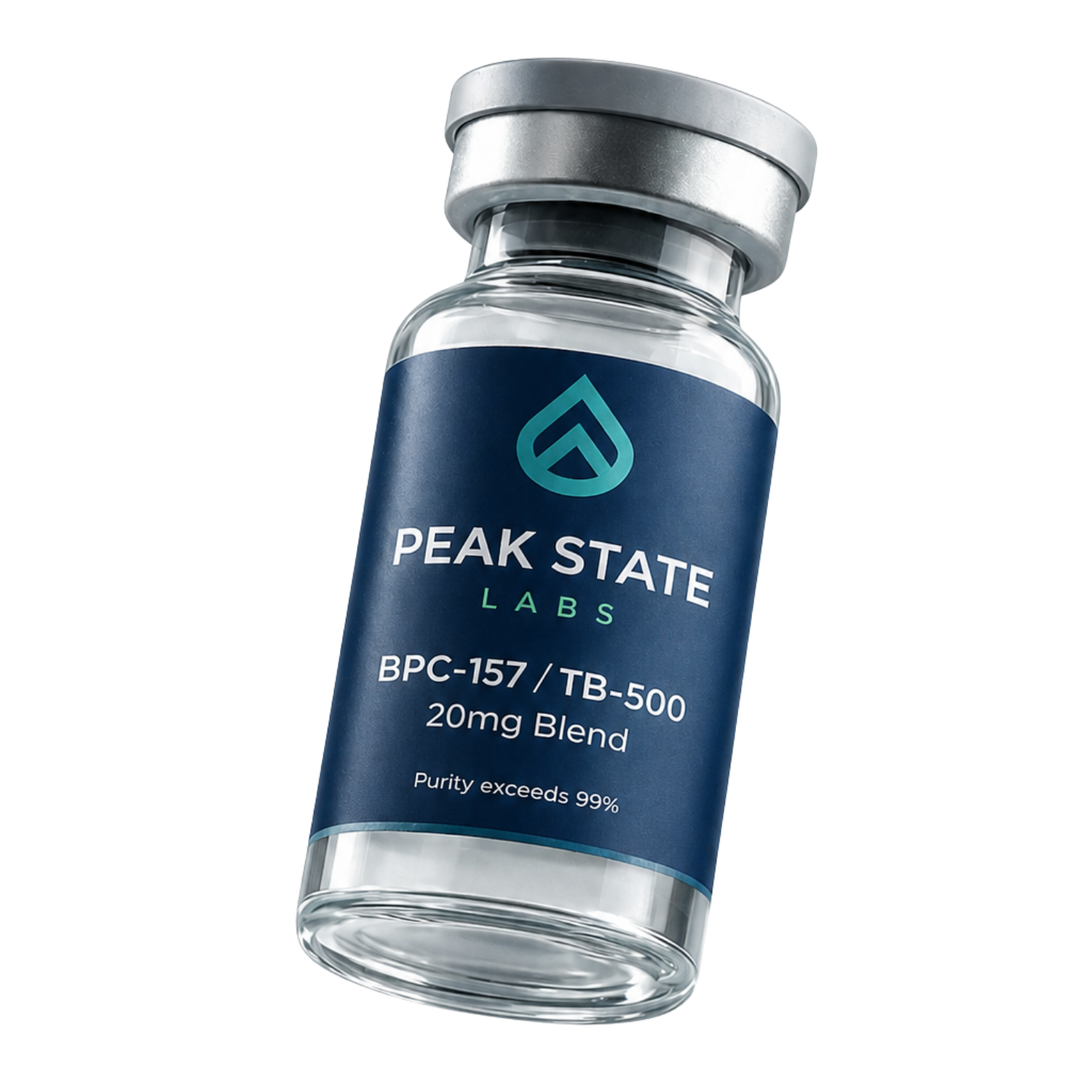
Blend
40 mg total
Class
Cytoprotective + Tβ4 fragment
Targets
VEGFR2 / G-actin
Half-life
~4 h / ~2–3 h
Overview
The BPC-157 + TB-500 protocol — colloquially known as the “Wolverine Stack” — is one of the most widely discussed regenerative-peptide combinations in the research literature. It pairs BPC-157 (Body Protective Compound, a 15-amino-acid synthetic peptide derived from a protective protein found in human gastric juice) with TB-500 (a synthetic fragment of thymosin β4 corresponding to its active actin-binding domain).
The two peptides target tissue repair through complementary but distinct mechanisms. BPC-157 acts primarily on the angiogenic and nitric-oxide axes — upregulating VEGFR2, modulating eNOS, and accelerating tendon-to-bone outgrowth in preclinical models. TB-500 sequesters monomeric G-actin, driving cellular migration, capillary formation, and recruitment of progenitor cells into damaged tissue. Used together, they cover both the local cytoprotective response and the broader systemic remodeling phase of soft-tissue recovery.
Both peptides remain investigational research compounds. They are not approved by the FDA, EMA, or any other regulatory body for human therapeutic use. Material referenced on this page is intended for laboratory research and educational reading only.
Mechanism of Action
The blend pulls on two independent levers of tissue repair. Each peptide contributes a distinct, additive signal at the site of injury.
Body Protective Compound (pentadecapeptide)
A 15-amino-acid peptide isolated from a protective fragment of human gastric juice protein. In preclinical models it upregulates VEGFR2 expression, modulates the nitric-oxide (NO) system via eNOS, accelerates tendon and ligament fibroblast outgrowth, and produces broad cytoprotective effects across the GI tract, tendons, ligaments, muscle, and CNS. Stable in gastric acid — one of the few peptides with documented oral activity in animal studies.
Thymosin β4 fragment (Tβ4 17–23, LKKTETQ)
A synthetic peptide corresponding to the active actin-binding region of naturally occurring thymosin β4. Sequesters monomeric G-actin, accelerating cell migration into wounded tissue, promoting endothelial-cell differentiation and capillary outgrowth, and recruiting bone-marrow-derived stem and progenitor cells to sites of injury. Systemic distribution gives it action beyond the immediate injection site.
Because BPC-157 and TB-500 act on different molecular targets — angiogenic signaling and growth-factor receptors versus actin-cytoskeleton dynamics and stem-cell recruitment — the two peptides are complementary rather than redundant. BPC-157 is the localized, fast-acting cytoprotective agent; TB-500 is the slower, more systemic remodeling agent. Together they cover both the early inflammatory phase and the later proliferative / matrix-remodeling phases of repair.
Pharmacokinetics
| BPC-157 — class | 15-amino-acid synthetic pentadecapeptide (gastric juice fragment) |
|---|---|
| TB-500 — class | 7-amino-acid active fragment of thymosin β4 (LKKTETQ) |
| Administration (research) | Subcutaneous injection (BPC-157 also studied via oral and intramuscular routes) |
| BPC-157 half-life | ~4 hours (plasma); local tissue effects persist longer |
| TB-500 half-life | ~2 – 3 hours (plasma); G-actin binding extends functional duration to several days |
| Onset of effect | Within ~1 – 2 weeks of consistent administration in preclinical models |
| Stability (BPC-157) | Stable in gastric acid — the only peptide in this class with documented oral activity |
| Elimination | Proteolytic degradation; renal clearance of fragments |
Reported Benefits in Research
Reported endpoints across the published preclinical literature and the broader BPC-157 / Tβ4 research base.
Tendon & ligament
Accelerated tendon-to-bone healing and fibroblast outgrowth in rodent Achilles and medial-collateral ligament transection models — the most cited BPC-157 endpoint.
Angiogenesis
Both peptides promote capillary formation: BPC-157 via VEGFR2 upregulation, TB-500 via endothelial-cell migration and tube formation.
Muscle repair
Faster recovery from crush and laceration injury in muscle models; TB-500 in particular has been studied in cardiac and skeletal-muscle repair.
GI cytoprotection
BPC-157 produces broad protection of gastric and intestinal mucosa against NSAIDs, alcohol, and stress-induced ulceration in rodent models.
Soft-tissue recovery
Subjects report reduced soreness, faster recovery between training sessions, and improved range of motion through a 6 – 12 week cycle.
Hair & skin
TB-500 has documented effects on hair-follicle stem-cell activation and dermal wound closure; anecdotal reports of improved skin texture.
Endpoints summarized from peer-reviewed publications and the broader BPC-157 + Tβ4 literature; see references below.
What to Expect
A general timeline of how response has progressed across the published literature and protocol observation. Individual results vary; values below describe ranges reported in research contexts and are not promises.
Week 1 – 2
Early reduction in inflammation and pain at the injury site. Mild improvements in sleep and recovery commonly reported. TB-500 loading dose (where used) is administered in this window.
Week 2 – 4
Noticeable improvements in joint comfort and range of motion. Reduced post-training soreness and steadier energy through the day. Most subjects feel the stack is “working” by the end of week 3.
Week 4 – 6
More substantial gains in tissue resilience: tendons and ligaments tolerate progressively greater load, and chronic minor strains often resolve. This is when most published case reports note their inflection point.
Week 6 – 8
For acute-injury research protocols, this is typically the end of the active cycle. Soft tissue is meaningfully remodeled; many subjects transition to maintenance dosing or cycle off.
Week 8 – 10
Maintenance window: dose tapers to once-daily BPC-157 with optional weekly TB-500. Continued connective-tissue improvement and stabilization of gains before the planned cycle-off period.
Timeline values reflect group-level outcomes in research settings. Adherence, dose, injury type, training stimulus, and baseline tissue health all materially influence individual response.
Reported Research Dosing
The following two protocols reflect the dosing structure Peak State Labs suggests for the 40 mg BPC-157 + TB-500 blended vial. Choose the cadence that fits your routine. Provided for reference only and not a recommendation for human use.
BPC-157 / TB-500 Structure
40 mg TotalFoundation Protocol
2x weeklyDesigned for simplicity and consistency. Best for those who want effective recovery with minimal injections and low friction.
- Dose per injection: 2.0 mg
- Schedule: Monday / Thursday
- Weeks 1 – 10: ON (2.0 mg per injection)
- Weeks 11 – 12: OFF (No dosing)
Performance Protocol
3x weeklyIncreased frequency for enhanced recovery signaling. Ideal for those looking to maximize results and don't mind a slightly higher level of commitment.
- Dose per injection: 1.3 mg (Mon) / 1.3 mg (Wed) / 1.3 mg (Fri)
- Schedule: Monday / Wednesday / Friday
- Weeks 1 – 10: ON (4.0 mg weekly total)
- Weeks 11 – 12: OFF (No dosing)
Both protocols use the same 40 mg blended vial and the same 10-week ON / 2-week OFF cycle. The Foundation Protocol delivers 4.0 mg per week across two subcutaneous injections; the Performance Protocol splits the same weekly volume across three smaller injections to maintain a more frequent regenerative-signaling pulse.
Cycle off for 2 full weeks before resuming. Slow titration on the first cycle is associated with reduced injection-site irritation and head-rush during the initial week.
Reconstitution & Storage
Reconstitution (research handling)
- • Wipe the rubber stoppers of both the lyophilized vial and the bacteriostatic-water vial with an alcohol swab.
- • Draw 2 mL of bacteriostatic water into a 3 mL syringe.
- • Inject the diluent slowly down the inside wall of the peptide vial; do not aim directly at the powder.
- • Swirl gently until fully dissolved. Do not shake.
- • At 2 mL into a 40 mg blended vial, each 0.1 mL contains 2.0 mg of the BPC-157 + TB-500 blend (one Foundation-Protocol dose).
Storage
- • Lyophilized: stable at room temperature short-term; refrigerate at 2 – 8 °C; long-term store at −20 °C.
- • Reconstituted: refrigerate at 2 – 8 °C and use within ~28 days.
- • Protect from light.
- • Avoid repeated freeze-thaw cycles after reconstitution.
- • Discard the vial immediately if cloudiness or particulate matter develops.
Storage parameters are general guidance for lyophilized peptide handling and may vary by batch — always defer to lot-specific documentation.
Reported Adverse Events
The BPC-157 + TB-500 combination is generally described as very well tolerated in published preclinical research and protocol literature, with most reported events mild, transient, and most often arising during the loading phase.
Long-term human safety data is limited. Both peptides remain investigational and have not been evaluated in large-scale controlled human trials. Theoretical concerns around enhanced angiogenesis warrant caution in any subject with a history of neoplastic disease.
Where the Blend Sits in the Regenerative-Peptide Class
| Compound | Mechanism | Profile |
|---|---|---|
| BPC-157 | VEGFR2 / eNOS / NO axis | Local cytoprotection; fast-acting; oral-stable |
| TB-500 | G-actin sequestration | Systemic remodeling; slow-acting; longer cycle |
| Thymosin β4 (full) | Native 43-aa peptide | Endogenous parent of TB-500; broader but less potent |
| GHK-Cu | Copper tripeptide | Skin remodeling; collagen synthesis; cosmetic focus |
| BPC-157 + TB-500 (Wolverine Stack) | Angiogenic + actin / migration | Synergistic, dual-phase soft-tissue repair blend |
References
- Sikiric P, et al. Stable gastric pentadecapeptide BPC-157: novel therapy in gastrointestinal tract. Current Pharmaceutical Design, 2010.
- Chang CH, et al. The promoting effect of pentadecapeptide BPC-157 on tendon healing involves tendon outgrowth, cell survival, and cell migration. Journal of Applied Physiology, 2011.
- Huang T, et al. Body protective compound-157 enhances alkali-burn wound healing in vivo and promotes proliferation, migration, and angiogenesis in vitro. Drug Design, Development and Therapy, 2015.
- Goldstein AL, Hannappel E, Kleinman HK. Thymosin β4: actin sequestering protein moonlights to repair injured tissues. Trends in Molecular Medicine, 2005.
- Crockford D, et al. Thymosin β4: structure, function, and biological properties supporting current and future clinical applications. Annals of the New York Academy of Sciences, 2010.
- Pep-Pedia. Wolverine Stack — BPC-157 + TB-500 Protocol. pep-pedia.org/peptides/wolverine-stack.
Citations are provided for educational reference. Refer to the original publications for full methodology and results.
BPC-157 + TB-500 is part of the POWER CUT™ Stack
Peak State Labs supplies the BPC-157 + TB-500 blend alongside Retatrutide and CJC-1295 + Ipamorelin in a single coordinated stack — with full third-party purity testing on every batch.